National Collection of American Art Renwick Gallery Smithsonian Institute
 | |
 Lincoln Gallery | |
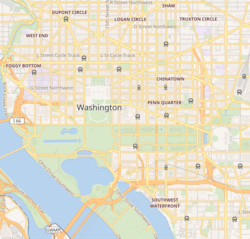
| Location in Washington, D.C. | |
| Established | 1829[1] |
|---|---|
| Location | eighth & F Streets NW, Washington, D.C.[2] |
| Coordinates | 38°53′52″N 77°01′24″Westward / 38.89778°N 77.02333°W / 38.89778; -77.02333 Coordinates: 38°53′52″N 77°01′24″West / 38.89778°Due north 77.02333°W / 38.89778; -77.02333 |
| Type | Art museum |
| Visitors | 1.2 million (2013)[3] |
| Managing director | Stephanie Stebich[iv] [v] [6] [seven] |
| Public transit access |     Gallery Place-Chinatown Gallery Place-Chinatown |
| Website | americanart |

The Smithsonian American Art Museum (commonly known every bit SAAM, and formerly the National Museum of American Fine art) is a museum in Washington, D.C., function of the Smithsonian Institution. Together with its branch museum, the Renwick Gallery, SAAM holds one of the world'south largest and most inclusive collections of art, from the colonial menses to the nowadays, fabricated in the United States. The museum has more than 7,000 artists represented in the drove. Most exhibitions take identify in the museum's main edifice, the old Patent Role Edifice (shared with the National Portrait Gallery), while arts and crafts-focused exhibitions are shown in the Renwick Gallery.
The museum provides electronic resource to schools and the public through its national pedagogy program. It maintains seven online enquiry databases with more than than 500,000 records, including the Inventories of American Painting and Sculpture that document more 400,000 artworks in public and private collections worldwide. Since 1951, the museum has maintained a traveling exhibition program; as of 2013, more than 2.5 million visitors have seen the exhibitions.
History [edit]
The museum's history can be traced to the creation of the Smithsonian Establishment in 1846. The act of Congress establishing the Smithsonian called for it to include "a gallery of art".[8] In its early years, however, fiddling effort was put into developing the art collection, equally Smithsonian Secretary Joseph Henry preferred to focus on scientific research.[nine] [10] The collection was first on brandish in the original Smithsonian Building (now known every bit the Castle). In 1865, a fire destroyed much of the drove.[xi] Those art holdings that survived were mostly loaned to the Library of Congress and the Corcoran Gallery of Art in the post-obit decades.[12] In 1896, the artworks were brought dorsum to the Smithsonian, later Congress appropriated money to construct a fireproof room for them.[13]
The Smithsonian began to refer to its fine art collection as the National Gallery of Fine art in 1906, in connection with efforts to receive Harriet Lane Johnston's art collection, which she had ancestral to the "national fine art gallery".[fourteen] The collection grew as the Smithsonian buildings grew, and the collection was housed in 1 or more Smithsonian buildings on the National Mall.[three]
In 1920, the National Gallery of Art was separated from the National Museum, becoming its ain branch of the Smithsonian, with William Henry Holmes every bit its first director.[15] [16] By this time, space had become critical: "Collections to the value of several millions of dollars are in storage or temporarily on exhibition and are crowding out important exhibits and producing a congested condition in the Natural History, Industrial Arts, and Smithsonian Buildings".[17] In 1924, builder Charles A. Platt drew up preliminary plans for a National Gallery of Art to exist built on the block next to the Natural History Museum.[17] However, this building was never constructed.[18]
In 1937, the National Gallery of Art became the National Collection of Fine Arts (NCFA), because Andrew Mellon insisted that the previous moniker be given to a new institution formed through his donation of a large fine art drove.[19] [20] [21]
By the 1950'southward, the NCFA still occupied a small-scale space in the Natural History Building.[22] In 1958, Congress finally granted the NCFA a home, the Old Patent Office Building, which was about to be vacated by the U.S. Civil Service Commission.[22] [23] The building would exist shared with the planned National Portrait Gallery, with the NCFA occupying the northern half of the building.[24] [25] Renovation work on the edifice began in 1964.[26] The NCFA opened in its new home on May half-dozen, 1968.[27]
The museum's relocation came at an unfortunate time, as the neighborhood had been devastated a month earlier by the Martin Luther King bump-off riots.[28] The NCFA struggled to attract visitors over the following decades, as the streets around information technology remained bleak and lonely.[29] This would remain a factor until the tardily 1990's, when the piece of work of the Pennsylvania Avenue Evolution Corporation and the opening of the MCI Center (at present Capital One Loonshit) beyond the street from the museum sparked a revitalization of the neighborhood.[30]
The NCFA gained a new branch in 1972, opening the Renwick Gallery, dedicated to design and crafts, in a historic edifice virtually the White House.[31]
In 1980, the proper noun was inverse to the National Museum of American Art, to better distinguish it from other federal fine art museums and to emphasize its focus on American artists.[32] [33]
In January 2000, the museum closed to brainstorm a planned three-year, $60-million renovation of the Patent Role Building.[34] To keep the museum's collection accessible to the public during the closure, many of the artworks were sent out in a "Treasures to Become" serial of traveling exhibitions, billed as "the largest museum tour in history".[35] [36] The museum'due south name was changed to the Smithsonian American Fine art Museum in Oct 2000 and then that the museum and its traveling exhibitions could benefit from the Smithsonian's make recognition.[37]
Afterward renovations were underway, the plans were broadened in an attempt to restore much of the building'southward original elegance.[38] Many of the building'southward exceptional architectural features were restored: porticos modeled after the Parthenon in Athens, a curving double staircase, colonnades, vaulted galleries, big windows, and skylights as long as a metropolis cake.[39] [40] [7] New features added to the building included the Lunder Conservation Center, the Luce Foundation Center for American Fine art, Nan Tucker McEvoy Auditorium, and the Robert and Arlene Kogod Courtyard.[40] Meanwhile, the museum'southward offices, library, and storage were moved to the nearby Victor Building, freeing up valuable infinite and allowing the museum to brandish 4 times as many artworks as before.[34] [41] The renovation ultimately took half dozen years and $283 one thousand thousand.[42] The museum and the National Portrait Gallery reopened their combined edifice, renamed as the Donald West. Reynolds Center for American Art and Portraiture, on July 1, 2006.[43]

The Smithsonian American Art Museum's chief edifice is shared with the National Portrait Gallery, as seen from Thou Street NW in 2011
Affiliated museums [edit]
National Portrait Gallery [edit]
The Smithsonian American Fine art Museum shares the historic Old Patent Office building with the National Portrait Gallery, another Smithsonian museum. Although the ii museums' names accept not changed, they are collectively known equally the Donald Due west. Reynolds Center for American Fine art and Portraiture.[39] [44]
Renwick Gallery [edit]

As well under the auspices of the Smithsonian American Art Museum, the Renwick Gallery is a smaller, celebrated building on Pennsylvania Avenue across the street from the White House.[45] The edifice originally housed the drove of the Corcoran Gallery of Fine art.[45] [46] In addition to displaying a large collection of American contemporary craft, several hundred paintings from the museum's permanent collection — hung salon style: one-atop-some other and side-by-side — are featured in special installations in the M Salon.[45]
Features and programs [edit]
Collections [edit]
Office of the Smithsonian Institution, the museum has a wide variety of American art, with more than 7,000 artists represented,[47] that covers all regions and art movements found in the United States. SAAM contains the earth's largest collection of New Deal art; a collection of contemporary craft, American impressionist paintings, and masterpieces from the Gold Age; photography, modern folk art, works by African American and Latino artists, images of western expansion, and realist art from the showtime half of the twentieth century. Among the meaning artists represented in its drove are Nam June Paik, Jenny Holzer, David Hockney, Georgia O'Keeffe, John Singer Sargent, Albert Pinkham Ryder, Albert Bierstadt, Frances Farrand Contrivance, Edmonia Lewis, Thomas Moran, James Gill, Edward Hopper, John William "Uncle Jack" Dey, Karen LaMonte[48] and Winslow Homer.[3]
SAAM describes itself as beingness "dedicated to collecting, understanding, and enjoying American art. The museum celebrates the extraordinary creativity of artists whose works reflect the American feel and global connections."[49]
Galleries and public spaces [edit]
The American Art's main edifice contains expanded permanent-drove galleries and public spaces.[fifty] The museum has ii innovative public spaces. The Luce Foundation Heart for American Art is a visible fine art storage and study heart, which allows visitors to browse more than 3,300 works of the collection.[50] The Lunder Conservation Center is "the first art conservation facility to allow the public permanent behind-the-scenes views of the preservation work of museums".[50]
The Luce Foundation Center for American Fine art [edit]

The Luce Foundation Centre for American Art on the third floor of the Smithsonian American Art Museum.
The Luce Foundation Center, which opened in July 2000,[51] [52] is the first visible art storage and study center in Washington, D.C.[39] and the fourth center to bear the Luce Family name.[39] [53] Information technology has 20,400 foursquare anxiety on the tertiary and quaternary floors of American Art Museum.[39] [54] [55] [56]
It presents more than iii,300 objects in 64 secure glass cases, which quadruples the number of artworks from the permanent collection on public view.[51] [39] The purpose of open storage is to allow patrons to view diverse niche art that is usually not role of a master exhibition or gala special.[54] The Luce Foundation Middle features paintings densely hung on screens; sculptures; crafts and objects by folk and self-taught artists arranged on shelves.[57] [58] Big-calibration sculptures are installed on the outset flooring.[51] The center has John Gellatly's European collection of decorative arts.[39] [56]
Lunder Conservation Center [edit]
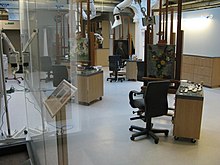
Lunder Conservation Eye Laboratory where the public is shown behind-the-scenes views of essential art preservation piece of work.
The Lunder Conservation Center, which opened in July 2000,[59] is the first fine art conservation facility that allows the public permanent behind-the-scenes views of preservation work.[59] Conservation staff are visible to the public through floor-to-ceiling glass walls that allow visitors to see firsthand all the techniques which conservators use to examine, treat, and preserve artworks.[threescore] [59] [61] The Lunder Center has five conservation laboratories and studios equipped to treat paintings, prints, drawings, photographs, sculptures, folk art objects, contemporary crafts, decorative arts, and frames.[lx] [59] The Centre uses various specialized and esoteric tools, such as hygrothermographs, to maintain optimal temperature and humidity to preserve works of art. Staff from both the Smithsonian American Art Museum and the National Portrait Gallery work in the Lunder Center.[59]
Selected exhibitions [edit]
The museum has put on hundreds of exhibitions since its founding. Many exhibitions are groundbreaking and promote new scholarship within the field of American art.
What follows is a brief listing of selected, and more recent, examples:[62]
- Ginny Ruffner: Reforestation of the Imagination (2019-2020)
- Michael Sherrill Retrospective (2019-2020)
- American Myth & Memory: David Levinthal Photographs (2019-2019)
- Artists Respond: American Art and the Vietnam War, 1965-1975 (2019-2019)
- Disrupting Craft: Renwick Invitational 2018 (2018-2019)
- Between Worlds: The Art of Bill Traylor (2018-2019)
- Trevor Paglen: Sites Unseen [63] (2018-2019)
- Diane Arbus: A box of ten photographs [64] (2018-2019)
- No Spectators: The Art of Burning Human being [65] (2018-2019)
- Do Ho Suh: Almost Dwelling house [66] (2018)
- Tamayo: The New York Years [67] (2017-2018)
- Murder Is Her Hobby: Frances Glessner Lee and The Nutshell Studies of Unexplained Death [68] (2017-2018)
- Kara Walker: Harper's Pictorial History of the Civil War (Annotated) [69] (2017-2018)
- Downward These Hateful Streets: Community and Place in Urban Photography [seventy] (2017)
- June Schwarcz: Invention and Variation [71] (2017)
- Gene Davis: Hot Beat [72] (2016-2017)
- Isamu Noguchi, Archaic/Modern [73] (2016-2017)
- Harlem Heroes: Photographs by Carl Van Vechten [74] (2016-2017)
- Visions and Revisions: Renwick Invitational 2016 [75] (2016)
- Artworks by African Americans from the Drove [76] (2016)
- The Art of Romaine Brooks [77] (2016)
- Ralph Fasanella: Lest We Forget (2014)
- Modern American Realism: The Sara Roby Foundation Collection (2014)
- Pop Art Prints (2014)
- Our America: The Latino Presence in American Art (2013)
- Landscapes In Passing: Photographs by Steve Fitch, Robbert Flick, and Elaine Mayes (2013)
- A Democracy of Images: Photographs from the Smithsonian American Fine art Museum (2013)
- Nam June Paik: Global Visionary (2012)
- The Civil State of war and American Art (2012)
- 40 under forty: Arts and crafts Futures (2012)
- African American Art: Harlem Renaissance, Ceremonious Rights Era, and Beyond (2012)
- The Art of Video Games (2012)
- Annie Leibovitz: Pilgrimage (2011)
- Multiplicity (2011)
- The Neat American Hall of Wonders (2011)
- Something of Splendor: Decorative Arts from the White Firm (2011)
- Alexis Rockman - A Fable for Tomorrow (2010)
- The W Every bit America (1991)
- Sandra C. Fernández: The Rise and Impact of Chicano Graphics
Outreach [edit]
The museum has maintained a traveling exhibition plan since 1951. During the 2000s renovation, a "series of exhibitions of more than than one,000 major artworks from American Fine art'southward permanent collection traveled to 105 venues beyond the Usa," which were "seen by more 2.v one thousand thousand visitors". Since 2006, thirteen exhibitions have toured to more than than thirty cities.[78]
SAAM provides electronic resource to schools and the public as part of education programs. An instance is Artful Connections, which gives real-time video conference tours of American Fine art. In addition, the museum offers the Summer Institutes: Teaching the Humanities through Art, week-long professional development workshops that innovate educators to methods for incorporating American art and engineering science into their humanities curricula.[79]
American Art has seven online research databases, which has more than 500,000 records of artworks in public and individual collections worldwide, including the Inventories of American Painting and Sculpture. Numerous researchers and millions of virtual visitors per year utilize these databases. Also, American Fine art and Heritage Preservation work together in a articulation project, Save Outdoor Sculpture, "dedicated to the documentation and preservation of outdoor sculpture". The museum produces a peer-reviewed periodical, American Fine art (started in 1987), for new scholarship. Since 1993, American Art has been had an online presence. It has one of the earliest museum websites when, in 1995, information technology launched its own website. EyeLevel, the first blog at the Smithsonian Institution, was started in 2005 and, as of 2013, the weblog "has approximately 12,000 readers each month".[eighty]
In pop culture [edit]
In 2006, mode designer Isaac Mizrahi designed the conservators' denim work aprons.[61] [81] [82]
In 2008, the American Fine art Museum hosted an alternate reality game, called Ghosts of a Risk, which was created by City Mystery. The game allowed patrons "a new way of engaging with the drove" in the Luce Foundation Center. The game ran for six weeks and attracted more than than 6,000 participants.[56]
See also [edit]
- List of most-visited art museums
- List of most-visited museums in the United States
References [edit]
- ^ "Museum History". Smithsonian Institution. Archived from the original on August xx, 2014. Retrieved May xi, 2014.
- ^ Calos, Katherine. "Heads volition turn". Times-Dispatch.
- ^ a b c "Smithsonian American Art Museum Fact Sheet, Feb 2014". Smithsonian Institution. Retrieved May 11, 2014.
- ^ Durón, Maximilíano (January 24, 2017). "Smithsonian American Art Museum Names Stephanie Stebich Managing director". ARTnews . Retrieved 28 March 2017.
- ^ McGlone, Peggy (January 24, 2017). "Smithsonian American Art appoints Tacoma Fine art Museum director". The Washington Post. ISSN 0190-8286. Retrieved 2017-05-03 .
- ^ "Smithsonian American Art Museum Staff Bios". Smithsonian Institution. Retrieved Dec 31, 2009.
- ^ a b Neary, Lynn (xiii Apr 2006). "D.C. Museums Well-nigh End of Pricey Facelift". All Things Considered. NPR. Retrieved 2 April 2013.
- ^ William H. Holmes (1922). Catalogue of Collections. Smithsonian Establishment National Gallery of Art. p. 3.
- ^ George Dark-brown Goode (1897). The Smithsonian Institution, 1846-1896: The History of Its First Half Century. Smithsonian Institution. p. 324.
- ^ Jane Van Nimmen (Jump 2016). "Helena E. Wright, The First Smithsonian Drove: The European Engravings of George Perkins Marsh and the Office of Prints in the U.Due south. National Museum". Nineteenth-Century Art Worldwide . Retrieved 2021-07-05 .
- ^ Homer T. Rosenberger (1969–1970). "Harriet Lane Johnston and the Formation of a National Gallery of Fine art". Records of the Columbia Historical Society, Washington, D.C. 69/70: 402. JSTOR 40067721.
- ^ William H. Holmes (1922). Catalogue of Collections. Smithsonian Institution National Gallery of Art. p. 4.
- ^ Annual Study of the Lath of Regents of the Smithsonian Institution (Report). Smithsonian Establishment. 1906. p. 21.
- ^ Richard Rathbun (1909). The National Gallery of Art. U.Southward. Government Press Role. p. 87.
- ^ "National Gallery of Fine art is made separate unit". The Evening Star. Washington, D.C. July 3, 1920 – via Newspapers.com.
- ^ Helena Wright (2015). The First Smithsonian Collection. Smithsonian Institution Scholarly Press. p. 256.
- ^ a b Proceedings of the Board of Regents of the Smithsonian Establishment at the Adjourned Coming together held Monday, Jan 5, 1925, Washington, D.C.: Smithsonian Institution, January 5, 1925, pp. 654–655
- ^ "SIA RU000092, Smithsonian Institution, Prints and Drawings, 1840-". Smithsonian Institution. Retrieved January 30, 2018.
Also included are... copies of drawings for the proposed National Gallery of Art (never constructed) by Charles A. Platt, 1924....
- ^ Homer T. Rosenberger (1969–1970). "Harriet Lane Johnston and the Formation of a National Gallery of Art". Records of the Columbia Historical Society, Washington, D.C. 69/70: 435–436. JSTOR 40067721.
- ^ "U.South. Statutes at Large, 75th Congress, 1st Session, Chapter 50" (PDF). Library of Congress. p. iii. Retrieved 2021-06-13 .
- ^ Gerald Griffin (May 9, 1937). "The nation's greatest art gift". The Baltimore Sun – via Newspapers.com.
- ^ a b Paul Sampson (April 2, 1958). "Exhibit to tell American art story". The Washington Post. p. A3. ProQuest 149078166. – via ProQuest (subscription required)
- ^ Pub.L. 85–357, Due south. 1984, 72 Stat. 68, enacted March 28, 1958
- ^ Leslie Judd Portner (Baronial 3, 1958). "Regime and the world of art". The Washington Post. p. E7. ProQuest 149043005.
Rep. Thompson introduced a bill providing that the building be transferred to the Smithsonian for its art collection and for a National Portrait Gallery. This bill became police force on March 28.
– via ProQuest (subscription required) - ^ "A new home for galleries is big pace". The Washington Mail service. April 22, 1962. p. G6. ProQuest 141730425. – via ProQuest (subscription required)
- ^ Leroy F. Aarons (October 9, 1966). "Patenting a yard gallery". The Washington Post. p. G11. ProQuest 143004144. – via ProQuest (subscription required)
- ^ Marker Stuart (May 6, 1968). "National fine art gets a new abode". The Morning Call. Paterson, NJ – via Newspapers.com.
- ^ Ally Schweitzer (August 23, 2017). "How the Washington Wizards saved the National Portrait Gallery". WAMU-FM . Retrieved 2021-06-27 .
- ^ Jo Ann Lewis (July 25, 1999). "The galloping gallery". The Washington Mail . Retrieved 2021-06-27 .
- ^ Jacob Comenetz (August 31, 2011). "Subsequently years of revitalization, Penn Quarter's personality shines". The Washington Diplomat . Retrieved 2021-06-27 .
- ^ "Renwick Gallery joins Smithsonian". Asbury Park Press. January 31, 1972 – via Newspapers.com.
- ^ "The Smithsonian Establishment today announded changes in the names..." United Press International. October sixteen, 1980 – via NewsBank.
- ^ Paul Richard (October 17, 1980). "National Drove gets a new name". The Washington Postal service. – via ProQuest (subscription required)
- ^ a b Ellen Sands (January xv, 2000). "Museums to exhibit new expect, new space". The Washington Times – via NewsBank.
- ^ Maria Puente (January 21, 2000). "'Treasures' tour shares the wealth of America's art". United states of america Today – via NewsBank.
- ^ Michael Kilian (January 23, 2000). "Capital idea". South Bend Tribune. Chicago Tribune – via NewsBank.
- ^ "American fine art museum adds Smithsonian to its name". Associated Press. October 31, 2000 – via NewsBank.
- ^ Stephen Goode (November 12, 2002). "Reinventing the Old Patent Edifice". Insight on the News – via NewsBank.
- ^ a b c d e f thou O'Rourke, Ronald. "Through a Glass More Clearly". Architecture DC.
- ^ a b "Near the American Art Museum and the Renwick Gallery". Smithsonian Institution. Retrieved 15 March 2013.
- ^ Glenn McNatt (June 25, 2006). "Seeing pictures of American life". The Baltimore Sun – via NewsBank.
- ^ Edward J. Sozanski (July 2, 2006). "Little-known museums now have room to abound". The Philadelphia Inquirer – via NewsBank.
- ^ Johanna Neuman (July ii, 2006). "National art in a new low-cal". Los Angeles Times . Retrieved 2021-06-26 .
- ^ Harvey, Eleanor (July 2006). "The New Smithsonian American Art Museum". The Mag Antiques. p. 76.
- ^ a b c "Architectural History of the Renwick Gallery". Smithsonian Institution. Archived from the original on 2004-04-30.
- ^ Reed, Robert (1980). Old Washington, D.C. in Early Photographs: 1846-1932 . Dover Publications. p. 127. ISBN9780486138541.
- ^ "Smithsonian American Fine art Museum" (PDF). Smithsonian Establishment. March 2012. Retrieved 29 March 2013.
- ^ Bell, Nicholas. "In Conversation: Nicholas Bell on Karen LaMonte". Smithsonian American Art Museum.
- ^ Smithsonian American Art Museum's Strategic Plan, 2012-2016
- ^ a b c "About the American Art Museum and the Renwick Gallery". Smithsonian Institution. Retrieved fifteen March 2013.
- ^ a b c Howard, Hilary (July 9, 2006). "Comings and Goings". The New York Times.
- ^ Hettger, Henry T. (September 12, 2006). "De Francisci featured in Luce Heart". Numismatic News.
- ^ Sherry, Karen A. (2006). "The Luce Center for American Fine art". American Art Review. XVIII (1): 112.
- ^ a b Gopnik, Blake (December 31, 2010). "Museum 'Closets' That Have Plenty In Shop for Visitors". The Washington Post. p. N3. Retrieved six April 2018.
- ^ Vogel, Ballad (July ii, 2004). "A Festive touch in Festive colors". The New York Times . Retrieved half-dozen April 2018.
- ^ a b c Baptiste, Laura (April 2009). "Luce Foundation Eye for American Art Fact Sheet" (PDF). Smithsonian Institution. Retrieved 29 March 2013.
- ^ Trescott, Jacqueline. "A Walk-In Closet for All". The Washington Mail . Retrieved 6 April 2018.
- ^ Lipske, Michael (Winter 2004). "Medal collection occupies interesting realm between art and currency".
- ^ a b c d eastward Terhune, Lea (Baronial vii, 2006). "Lunder Conversation Center allows visitors to see conservators at work". USInfo at State.gov.
- ^ a b "Gallery Reopens with Unique Education and Conservation Centers". Arts Washington. September–Oct 2006.
- ^ a b Macadam, Alison (30 June 2006). "Art Conservators at Work: A Living Exhibit". All Things Considered. NPR. Retrieved 6 April 2018.
- ^ "By exhibitions". Smithsonian Establishment. Retrieved 12 May 2014.
- ^ "Trevor Paglen: Sites Unseen". Smithsonian American Art Museum.
- ^ "Diane Arbus: A box of ten photographs". Smithsonian American Art Museum.
- ^ "No Spectators: The Fine art of Burning Human being". Smithsonian American Art Museum.
- ^ "Do Ho Such: Most Home". Smithsonian American Fine art Museum.
- ^ "Tamayo: The New York Years". Smithsonian American Art Museum.
- ^ "Murder Is Her Hobby: Frances Glessner Lee and The Nutshell Studies of Unexplained Death". Smithsonian American Art Museum.
- ^ "Kara Walker: Harper's Pictorial History of the Civil State of war (Annotated)". Smithsonian American Art Museum.
- ^ "Down These Mean Streets: Customs and Identify in Urban Photography". Smithsonian American Art Museum.
- ^ "June Schwarcz: Invention and Variation". Smithsonian American Art Museum.
- ^ "Gene Davis: Hot Beat". Smithsonian American Art Museum.
- ^ "Isamu Noguchi, Archaic/Modern". Smithsonian American Art Museum.
- ^ "Harlem Heroes: Photographs by Carl Van Vechten". Smithsonian American Fine art Museum.
- ^ "Visions and Revisions: Renwick Invitational 2016". Smithsonian American Art Museum.
- ^ "Artworks by African Americans from the Collection". Smithsonian American Fine art Museum.
- ^ "The Fine art of Romaine Brooks". Smithsonian American Art Museum.
- ^ "National Outreach". Smithsonian Establishment. Retrieved fifteen March 2013.
- ^ "Education Outreach". Smithsonian Institution. Retrieved 15 March 2013.
- ^ "National Outreach". Retrieved 15 March 2013.
- ^ Taylor, Caroline (July 2006). "New features fill Reynolds Centre". The Torch.
- ^ Choi, Amy S. (June xxx, 2006). "Smithsonian Staff to Don Mizrahi Aprons". Women'south Wearable Daily. p. 27. Retrieved 2 April 2013.
External links [edit]
- Official website
- Luce Foundation Center at SAAM
- Lunder Conservation Center at SAAM
- Rosenbaum, Lee (Aug 29, 2006). "Smithsonian American Art Museum". Wall Street Journal.
chaissonwayinshound.blogspot.com
Source: https://en.wikipedia.org/wiki/Smithsonian_American_Art_Museum
0 Response to "National Collection of American Art Renwick Gallery Smithsonian Institute"
Post a Comment